New Jersey Teaching Salaries and Benefits

New Jersey elementary school teachers earned a median annual wage of $78,200 as of May 2025, according to the Bureau of Labor Statistics, among the highest in the country. Public school teachers also receive a lifetime pension through the Teachers’ Pension and Annuity Fund (TPAF) and health coverage through the School Employees’ Health Benefits Program (SEHBP). Exact pay and plan options vary by district.
Sponsored School(s)


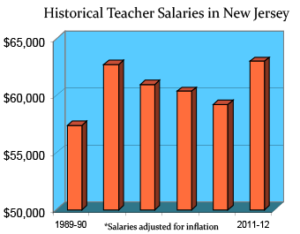 New Jersey pairs some of the strongest teacher pay in the country with a defined benefit pension and district-negotiated health coverage. That combination is why the state routinely ranks near the top nationally for starting and average teacher salaries. Pay still varies by district, since New Jersey funds public education primarily through local property taxes, and health and retirement benefits carry rules that apply to every public school teacher in the state regardless of district.
Learn more about becoming a teacher. Contact schools offering teacher education/certification programs in New Jersey. If you’re already certified and due for renewal, see our New Jersey teacher certification renewal guide.
Use the links below to jump to salary data, pension details, and health insurance information for New Jersey teachers.
- Teacher salaries in New Jersey by grade level
- TPAF retirement and pension benefits
- Health insurance for New Jersey teachers
- Frequently asked questions
Teacher Salaries in New Jersey
Salaries for New Jersey teachers increase with years of experience and with additional education, such as a master’s degree or graduate credits beyond a bachelor’s. Each district negotiates its own salary guide with its local teachers’ union, so the exact steps and increases differ from one district to the next. Statewide wage data from the Bureau of Labor Statistics gives a clearer picture of where New Jersey teacher pay stands by grade level.
| Grade Level | Median Annual Wage |
|---|---|
| Kindergarten Teachers | $74,210 |
| Elementary School Teachers | $78,200 |
| Middle School Teachers | $78,770 |
| High School Teachers | $82,200 |
| Grade Level | Job Growth (2024-2034) |
|---|---|
| Kindergarten Teachers | 5.6% |
| Elementary School Teachers | 5.5% |
| Middle School Teachers | 5.5% |
| High School Teachers | 5.8% |
New Jersey’s projected job growth for teachers runs ahead of the national trend at every grade level, according to the New Jersey Department of Labor and Workforce Development, with an average of roughly 3,390 elementary teaching openings and 2,610 high school teaching openings expected each year through 2034 from retirements and turnover alone.
Retirement and Pension Benefits
Once you’re hired as a public school teacher in New Jersey, you’re enrolled in the statewide Teachers’ Pension and Annuity Fund (TPAF), a defined benefit pension plan administered by the New Jersey Division of Pensions and Benefits. TPAF pays a lifetime monthly pension based on your years of service and your final average salary, funded by contributions from both you and your employer.
Your pension amount is calculated using a set formula: your years of service divided by 55, multiplied by your final average salary (based on your three highest-paid years). For example, a teacher retiring after 30 years of service with a final average salary of $62,000 would receive about $2,818 per month.
You qualify for a full, unreduced pension once you reach age 65, or earlier under certain tier and service-year combinations set by TPAF rules. New Jersey teachers are also covered by Social Security in addition to TPAF, unlike public employees in some other states, so your pension supplements rather than replaces Social Security income.
To review current contribution rates, vesting requirements, and retirement tiers, contact the New Jersey Division of Pensions and Benefits directly, since rates and tier rules are set by the state and can change.
Health Insurance for New Jersey Teachers
New Jersey public school teachers get health coverage through the School Employees’ Health Benefits Program (SEHBP), administered by the state Division of Pensions and Benefits. Each district still negotiates specifics like premium-sharing and plan tier with its local teachers’ union, so your out-of-pocket costs depend on where you teach.
SEHBP plans typically include coverage for:
- Physician visits
- Prescription drugs
- X-ray and laboratory services
- Hospital care
- Emergency room visits
Districts commonly offer several SEHBP medical plan options side by side, along with an optional dental plan for teachers and their families. Ask your district’s HR or benefits office which specific plans are available before your enrollment window, since options can differ by district and by year.
Frequently Asked Questions
What is the average teacher salary in New Jersey?
Pay varies by grade level and district, but BLS data puts the median annual wage at $78,200 for elementary teachers and $82,200 for high school teachers as of May 2025. Experience, education level, and district salary guides all affect where an individual teacher lands within that range.
Do New Jersey teachers get a pension?
Yes. Public school teachers are enrolled in the Teachers’ Pension and Annuity Fund (TPAF), a defined benefit plan that pays a lifetime monthly pension based on years of service and final average salary. Both the teacher and the employer contribute to the fund throughout the teacher’s career.
Do New Jersey teachers pay into Social Security?
Yes. Unlike teachers in some other states, New Jersey teachers are covered by Social Security in addition to TPAF. That means retirement income typically comes from both TPAF and Social Security rather than a pension alone.
What health insurance do New Jersey teachers have?
New Jersey public school teachers are covered through the School Employees’ Health Benefits Program (SEHBP), which offers several medical plan options along with optional dental coverage. Districts negotiate their own premium-sharing arrangements, so costs vary by employer.
Does teacher pay in New Jersey vary by district?
Yes. New Jersey school districts each negotiate their own salary guide with the local teachers’ union, so starting pay and step increases differ across the state. Districts near major metro areas or with higher local tax bases often post higher salary guides than smaller or rural districts.
- New Jersey pay ranks among the highest nationally — median wages range from $74,210 for kindergarten teachers to $82,200 for high school teachers as of May 2025, per BLS data.
- TPAF provides a lifetime pension — benefits are calculated as years of service divided by 55, multiplied by final average salary, funded by both teacher and district contributions.
- Social Security applies on top of TPAF — New Jersey teachers aren’t limited to a pension alone, unlike educators in some other states.
- Health coverage runs through SEHBP — districts pick from several state-administered medical plans and negotiate cost-sharing locally.
- Pay and benefits both vary by district — always check the specific district’s salary guide and benefits package before comparing offers.
Ready to start your path to teaching in New Jersey? Explore approved teacher preparation programs and learn about New Jersey’s educator certification requirements.
May 2025 US Bureau of Labor Statistics OEWS wage estimates and 2024-2034 employment projections for Kindergarten and Elementary School Teachers, Middle School Teachers, and High School Teachers, reflect state and national data, not school-specific outcomes. State or district job-growth projections are sourced separately from national BLS outlook data. Conditions vary by school sector, subject area, and district. Data accessed July 2026.